
French Trained Osteopath
D.O(F), DOMP


Jessica Bonzon
My last day at Healthone will be
Friday August 21, 2026
For all inquiries:


I encourage new patients to visit my French colleagues,
Pierre Boachon at Sage Health and Wellness
(Yonge & Wellesley)
or Robin Guillen at Step Up (Yonge & Wellington)

Jessica Bonzon DOMP is an active member of
the Ontario Association of Osteopathic Manual Practitioners (OAO) and the Canadian Society for Traditional Osteopathy (So.Ca.T.O.)


OSTEOPATHY: a non-invasive manual therapy focused on restoring balance, mobility, and function throughout the body.
A.T Still (1828-1917), inventor of osteopathy
Andrew Taylor Still was an American physician and the founder of osteopathy. In 1864, after losing several of his children during a meningitis epidemic, he began to question the limitations of conventional medicine of his time. This turning point led him to explore a new philosophy of healthcare focused on the body’s structure, function, and innate ability to heal.
On June 22, 1874, he formally introduced this approach, which he named osteopathy.
Today, osteopaths continue to practice within this tradition, using skilled manual techniques to assess and treat the body. Becoming an osteopath requires the completion of a comprehensive five-year full-time program in osteopathic studies, combining medical sciences, clinical training, and hands-on practice.

What is osteopathy?

Osteopathy is a non-invasive, hands-on approach to healthcare grounded in a holistic understanding of the body. It is based on the principle that the body’s systems are interconnected and function as an integrated whole. Rather than focusing only on the area of pain, osteopathy seeks to understand the broader patterns contributing to your symptoms.
Often, symptoms are signals of underlying dysfunction elsewhere in the body.
An osteopath’s role is to identify these areas of restriction and address them, supporting the body’s natural capacity to regulate and restore balance.
Through skilled manual assessment and treatment, osteopaths use a personalized combination of techniques, including musculoskeletal, fascial, craniosacral, and visceral approaches, to improve mobility, reduce tension, and optimize function.
Osteopathy for all ages
Osteopathy is for all stages of life.
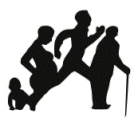
It can support newborns in their first days, pregnant women, athletes seeking to optimize performance, adults managing daily physical demands, and seniors maintaining mobility and comfort.
There are no age, gender, or body type restrictions for receiving osteopathic care.
Each technique is carefully selected and adapted to the individual, taking into account age, health status, and any medical contraindications. Osteopathic treatment is never forceful; it is tailored, respectful, and guided by the body’s capacity to respond.
What does an osteopath treat ?
There are three main reasons people seek osteopathic care:
1. Pain and musculoskeletal discomfort
Pain, stiffness, or reduced mobility affecting joints, muscles, or connective tissues. Common complaints include back and neck pain, joint pain such as hip, knee, ankle, shoulder, or elbow, jaw tension, sprains, tendinopathies, arthritis-related discomfort, sciatica, and nerve-related pain patterns.
2. Functional concerns
Osteopathy may also support certain functional disturbances, such as digestive discomfort including bloating, constipation, reflux, headaches, vertigo, tinnitus, stress-related tension, sleep disturbances, and fatigue.
3. Prevention and maintenance
Pain often develops when the body has been compensating for strain or imbalance over time. Preventive care aims to identify and address restrictions early, before they progress into more significant discomfort. Periodic check-ins can help maintain mobility and overall function.
Osteopathy may also be helpful:
-
After trauma such as a fall or motor vehicle accident
-
During pregnancy and postpartum
-
For infants with positional asymmetries or feeding-related tension
-
For children experiencing growth-related strain
-
For athletes before or after competition
But osteopathy has its limits and does not pretend to cure everything!


Informations & Contact

